Wednesday 21st October 2026
Specialist GP gives way to multi-asset giants in first Private Markets 100

PEI Group’s inaugural Private Markets 100 finds the 100 largest managers raised US$5.74 trillion over 2021 to 2025. Multi-strategy platforms dominate, with seven of the top 10 active across all five asset classes.
PEI Group has put a number on the scale of private markets, with its inaugural Private Markets 100 ranking finding the 100 largest managers raised US$5.74 trillion between 1 January 2021 and 31 December 2025. According to the report, that total exceeds the annual economic output of Germany.
The ranking is the first to measure private equity, real estate, infrastructure, private credit and secondaries together. It consolidates PEI Group’s six established asset class rankings, each compiled from manager submissions and validated against public filings, regulatory disclosures and fund documentation. A manager needed US$18.97 billion to make the list.
For advisers building private market exposures into client portfolios, the ranking offers a clear picture of who raises the capital, and where that capital goes.
Growth all round
All six rankings feeding the Private Markets 100 record higher five-year totals than in the previous edition. PEI Group says this is the first time it has happened simultaneously since it began tracking such totals.
The PEI 300 for private equity reaches US$3.55 trillion, up 7.9 per cent and ending the plateau recorded in 2025. The PEI Private Credit 200 climbs to US$2.35 trillion from US$2.09 trillion. The Secondaries Investor 50 rises 12 per cent to US$584.6 billion, its second consecutive year of double-digit growth.
The Infrastructure Investor 100 totals US$1.2 trillion, following a record US$260 billion single year in 2025. The PERE 200 closed-end real estate ranking returns to growth for the first time since 2023, adding US$57 billion to reach US$834 billion.
Growth is not entirely uniform. The infrastructure ranking’s entry threshold slips from US$1.7 billion to US$1.6 billion, the first such reversal in its history, even as the asset class keeps growing.
Fewer specialists
The standout finding is the steady decline of the single-strategy manager. Measuring all five asset classes together “confirms that the specialist GP is disappearing,” the report states, with GP meaning general partner, the firm that runs the fund.
Sixteen of the top 100 firms raise capital across all five strategies, and seven of the top 10 are active in all five. A further 13 firms operate across four strategies, while 17 of the top 20 are active in at least four.
Acquisitions drive much of that shift. KKR has acquired Arctos Partners, EQT has acquired Coller Capital. Goldman Sachs has acquired Industry Ventures while General Atlantic has merged with Actis. BNP Paribas has completed its purchase of AXA Investment Managers.
As a result, the firms at the top of the list “have ceased to be recognisable solely as the buyout houses, real estate managers or credit specialists they were a decade ago.”
Blackstone tops the ranking with US$356.68 billion, ahead of KKR on US$302.15 billion, Goldman Sachs Alternatives on US$215.29 billion, EQT on US$204.30 billion and Ares Management on US$191.94 billion. Blackstone best shows private credit’s rise, with its five-year credit fundraising nearly matching its private equity total. Both exceed US$111.5 billion.
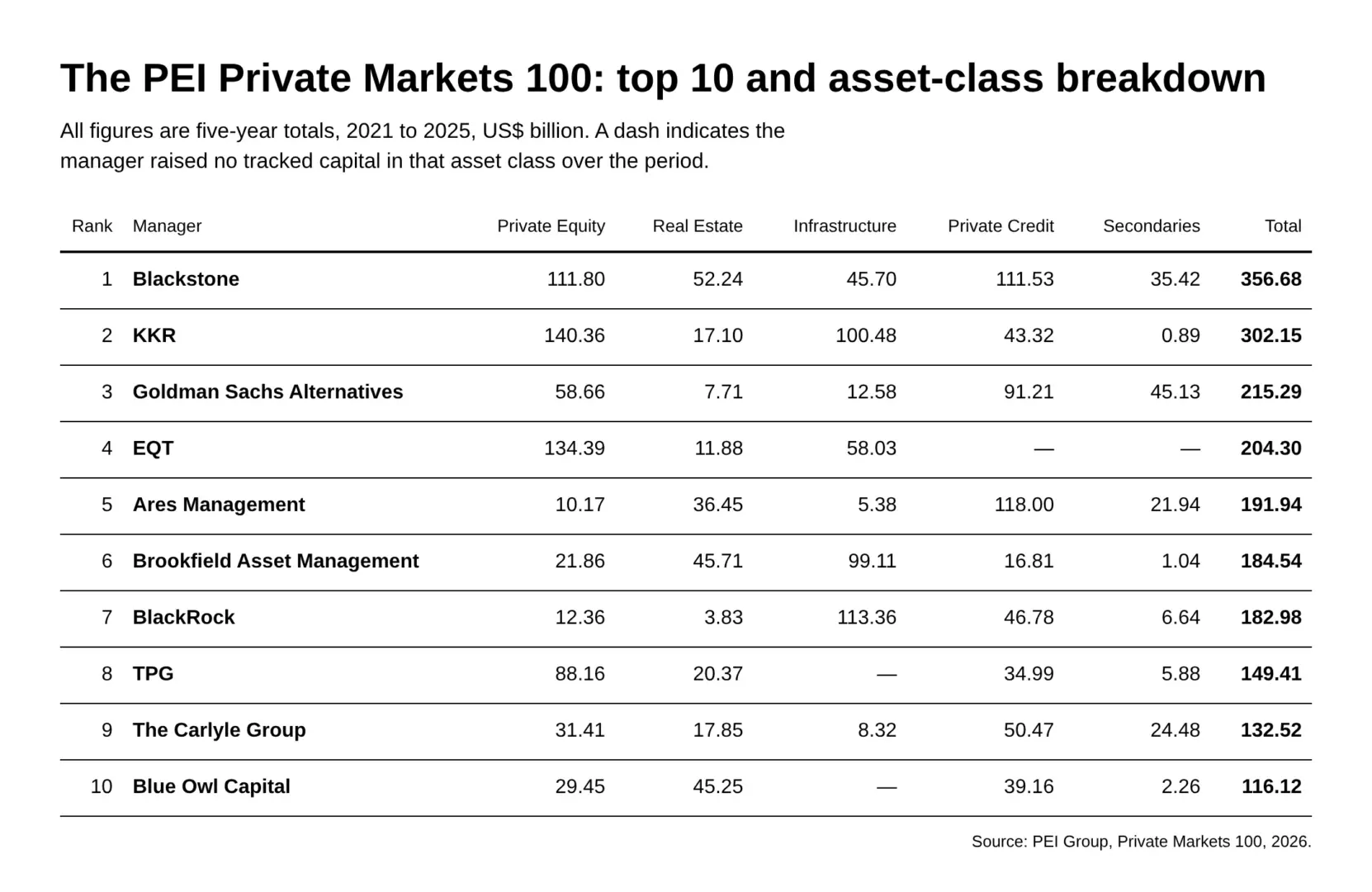
Two Australian managers make the list. Macquarie Asset Management ranks 13th with US$104.90 billion, including US$87.88 billion for infrastructure, and IFM Investors ranks 77th with US$24.24 billion.
Where the capital flows
Private equity remains the largest contributor, accounting for US$2,165.4 billion, or 37.7 per cent, of the top 100’s fundraising. Private credit follows with US$1,691.0 billion (29.5 per cent), ahead of infrastructure on US$870.4 billion (15.2 per cent), real estate on US$513.2 billion (8.9 per cent) and secondaries on US$501.5 billion (8.7 per cent).
Concentration varies widely by asset class. The top 100 account for 67 per cent of all private credit capital and 80 per cent of all secondaries capital across PEI Group’s full data set. In private equity and real estate, by contrast, mid-sized and regional specialists still take a meaningful share.
Room to run
Private credit’s growth shows no sign of fading. PEI surveyed LPs (limited partners, such as superannuation funds) for its June 2026 Private Credit H1 Investor Report. Just under two-thirds (63 per cent) say they remain underallocated.
Private equity deals make up around 80 per cent of private credit deal volume. The report points to US$1.75 trillion of buyout dry powder as a large addressable market.
Infrastructure draws on two of the largest investment trends in the world, the energy transition and digital infrastructure. The report describes the latter as “turbocharged by the AI capital expenditure supercycle.”
Secondaries, once a cottage industry trading second-hand fund stakes, has grown into what many see as “the hottest strategy of all.” Annual capital raised for the strategy rises sixfold over the decade to 2025, peaking at US$154.8 billion in that year.
Real estate lagged as a driver of capital raising from 2021 to 2025 after a period of underperformance and repricing. Even so, the report remains confident in its role as a source of income and diversification. It notes that “real estate is still a cyclical business and what has come down must eventually rise back up.”
When selecting private market managers for client portfolios, the ranking offers a useful map. It shows the firms shaping each asset class, and the growing number able to provide access across all five.

Cristina is a contributor and content manager at The Inside Network.