Thursday 27th August 2026
Ten managers, one verdict on ASX20 concentration

Ten active Australian equity managers agree: ASX20 concentration is distorting prices at the top of the market and widening the gap between index heavyweights and everything below. For FY27, the opportunity sits in that gap.
ASX20 concentration is at the centre of a debate reshaping how advisers think about Australian equity allocations. The top 20 stocks make up roughly 60 per cent of the ASX200 by market capitalisation, a figure a survey of ten active Australian equity managers puts front and centre, and one that lines up with independent data from Market Index and ASX20List.com.
Building or reviewing an Australian equity allocation means working with a concentrated index whether you choose to or not. That concentration changes the maths on a passive position, and it is not just a manager talking point.
Morningstar data shows passive strategies pulled in $7.7 billion of net flows across Australian funds and ETFs in the December 2025 quarter, against $2.5 billion for active strategies. Betashares figures cited by AXIS put April 2026 passive ETF inflows at $5.06 billion against just $336 million for active ETFs.
A growing number of active managers argue the resulting valuation gaps, not index returns, are where FY27’s opportunities sit.
ASX20 concentration is doing the price setting
The first theme is about market structure rather than any one stock. Several managers pointed out that index weighting and ETF flows, not company fundamentals, are increasingly setting prices at the top of the market.
“As more money moves into passive investing we think this is creating an increasing number of mispricing opportunities,” Auscap Asset Management said.
L1 Capital made a similar point: greater stock dispersion and volatility are creating situations where the market may be overreacting to short-term issues or underestimating individual businesses.
The chain reaction is easy enough to trace. Capital flows into the ASX20 because it is the index. That pushes up prices regardless of valuation, widening the gap between those companies and everything ranked below them.
As Firetrail Investments sees it:
“The most attractive opportunities now sit beyond the mega caps, where valuations are lower, earnings growth is stronger and passive distortion is far smaller.”
Valuation dispersion by sector
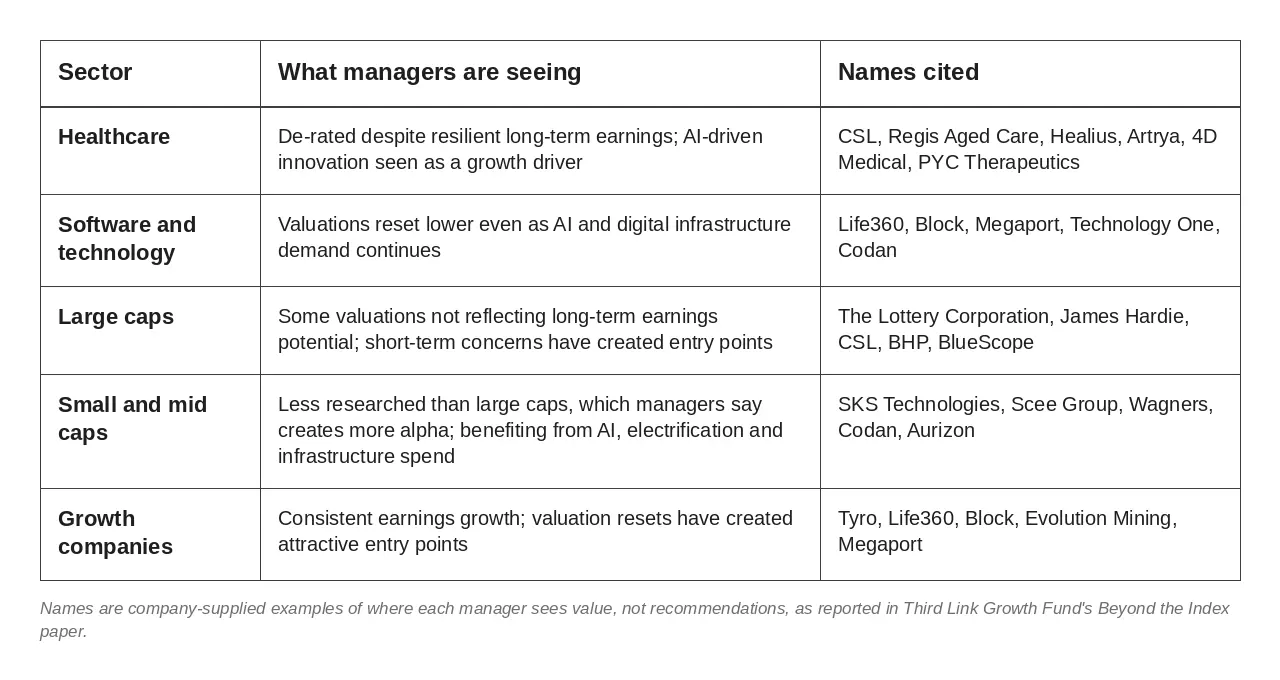
The managers’ most concrete observations were sector-specific. Healthcare has de-rated despite resilient long-term earnings, several managers noted. Quality names have sold off harder than their fundamentals justified.
Software saw a similar reset. At the other end, bank valuations were described as stretched even as AI-related names pulled in disproportionate capital.
ECP Asset Management framed the underlying logic: “While sentiment and narratives can influence share prices in the short run, the economics of a business is what drives long-term investment returns.”
Chester Asset Management made the same case from the momentum side. Share prices can run well beyond fair value before eventually normalising, and that gap is where patient active managers look to add value.
Where the managers are finding value by sector
AI exposure is not one trade
One point worth flagging for clients asking about AI: none of the surveyed managers are trying to own AI directly. Instead, they are spread across the ecosystem AI depends on. That spans data centres and power generation through to copper and other resources, electrical contractors, software and AI-enabled medical devices.
Eiger Capital called AI medical device companies “probably one of the most exciting themes to watch heading into FY27.” 1851 Capital took a different route into the same theme. It backed “electrical contractors SKS Technologies and Southern Cross Electrical” rather than the capital-intensive data centre operators themselves.
The spread is vital for portfolio construction. A single AI-themed allocation can mean very different underlying exposures depending on where in that chain a manager is positioned. The managers surveyed here are deliberately not clustered in one part of it.
Volatility at the stock level, calm at the index level
The ASX300 posted another positive year in FY26, but that headline number obscured what was happening underneath it. Managers pointed to individual ASX20 stocks moving between 10 and 40 per cent in a single day. That level of dispersion does not show up in the index return.
Australian Eagle Asset Management cited Cochlear’s largest single-day fall in 30 years as an example. None of these figures are independently verified here; they are the managers’ own characterisations of the year.
This kind of dislocation, uncomfortable as it is for anyone watching a single stock, is where active stock-picking earns its keep. As Eiger Capital put it, “staying close to companies and understanding the drivers of their success has never been more important.”
What it means for FY27 allocations
Taken together, the themes point to a market where the index and the opportunity set are diverging. Several managers also expect corporate activity to pick up. Mergers, acquisitions and private equity interest are all on the table as valuation gaps make quality listed businesses harder for trade buyers to ignore.
Passive exposure still has a place. What it cannot do is sidestep ASX20 concentration or control the price at which it takes it.
Ten managers, working independently, have converged on the same widening gap. For advisers reviewing client portfolios ahead of FY27, that is reason enough to check whether a client’s concentrated ASX20 bet still matches their risk profile.

Cristina is a contributor and content manager at The Inside Network.