Thursday 18th June 2026
Active ETFs just got more interesting for Australian investors
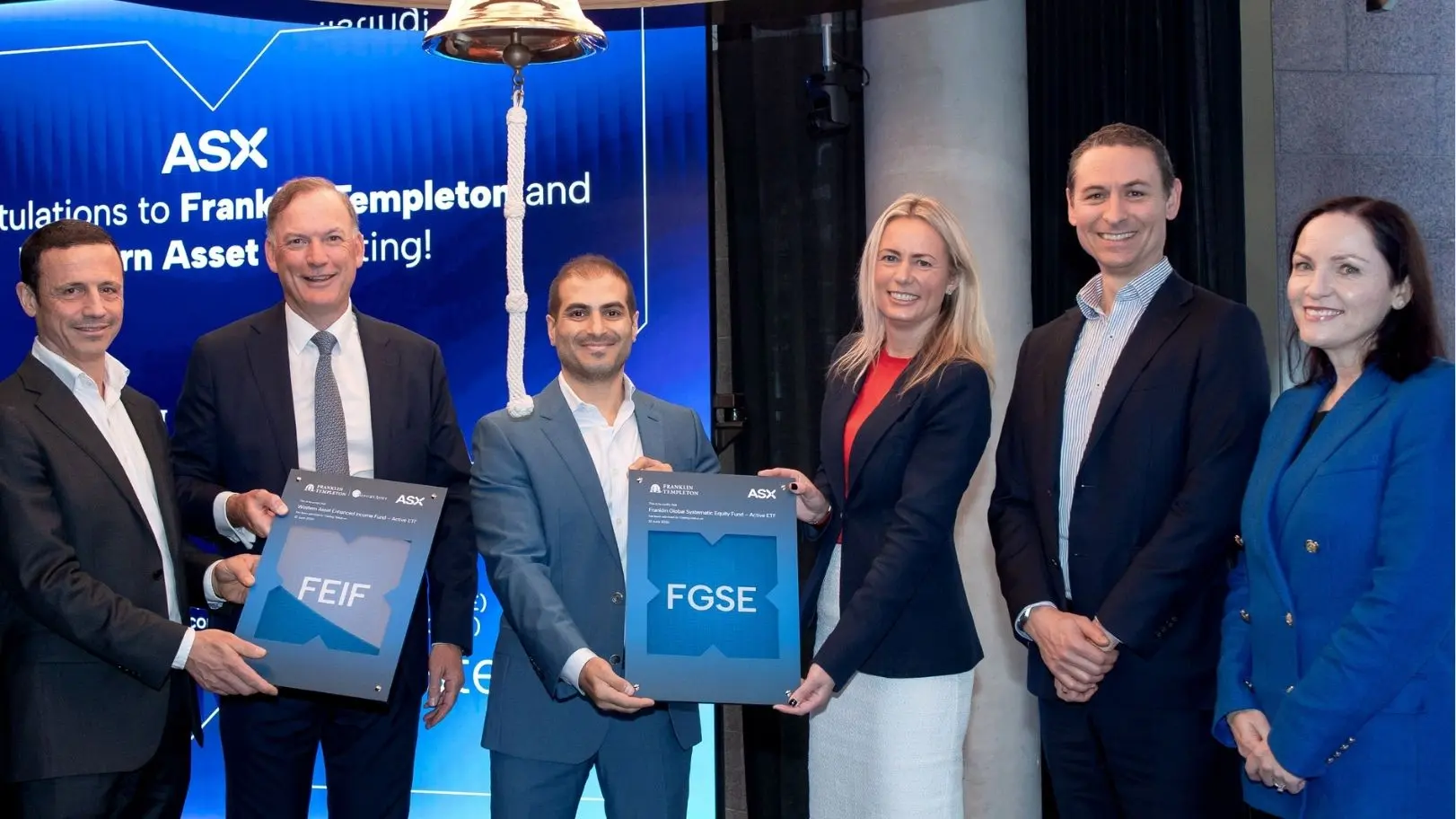
The global asset manager expands its local active ETF suite to nine products, with a fixed income play and a global equity strategy now live on the ASX.
The ETF market has changed. What started as a passive investing revolution is quietly becoming something more sophisticated, and the numbers back it up. Active ETFs have now topped $1.8 trillion globally, with inflows into active strategies doubling as a proportion of all ETF assets since 2022.
Franklin Templeton is leaning into that shift. The global asset manager has launched two new active ETFs on the ASX, bringing its local active ETF range to nine products. The two new additions are the Franklin Global Systematic Equity Fund (FGSE) and the Western Asset Enhanced Income Fund (FEIF).
Both strategies are built on a simple but powerful premise: you do not have to choose between the convenience of an ETF and genuine active management. You can have both.
What is an active ETF and why does it matter?
For advisers still explaining the concept to clients, it helps to separate the two components.
The ETF part means the fund trades on the ASX like a share. It offers daily liquidity, price transparency and typically lower costs than traditional managed funds. These are features investors have come to expect and value.
The active part means a portfolio manager is making deliberate decisions about what goes into the fund. Unlike an index ETF that simply tracks a benchmark, an active ETF aims to beat it. The manager selects securities, manages risk and responds to market conditions in real time.
Put the two together and you get a structure that suits how many Australians actually want to invest today: accessible, transparent and managed with genuine skill.
The growing appetite for active ETFs in Australia reflects exactly that shift. Local investors are increasingly drawn to strategies that combine the convenience of the ASX wrapper with active portfolio decision-making.
“Investors today want more choice in the ETF space,” says Felicity Walsh, Franklin Templeton’s Managing Director for Australia and New Zealand. “Our range of active ETFs are designed to bring together the liquidity and transparency of a listed structure with an active and intelligent approach to portfolio management.”
The fixed income option: FEIF
The Western Asset Enhanced Income Fund (ASX: FEIF) targets investors who want more from the fixed income portion of their portfolio.
It is a short-duration, high-quality credit strategy. That matters right now because many investors are cautious about locking in long-duration exposure in an uncertain rate environment. FEIF is designed to generate meaningful income above the cash rate without taking on significant interest rate sensitivity.
The fund targets returns that exceed the Bloomberg AusBond Bank Bill Index by 1.5 to 2 per cent per annum. Measured over rolling three-year periods. The numbers speak for themselves. After fees, the underlying managed fund returned 6.12 per cent over one year and 7.54 per cent per annum over three years to 30 April 2026. The benchmark returned 3.79 per cent and 4.16 per cent over the same periods.
Anthony Kirkham, co-chief investment officer at Western Asset Management, describes it as a genuinely differentiated option for investors seeking yield without duration risk. The underlying managed fund holds Recommended ratings from both Lonsec and Zenith Investment Partners.
The global equity option: FGSE
The Franklin Global Systematic Equity Fund (ASX: FGSE) takes a different approach. It offers broad global equity exposure. The approach uses a quantitative process that analyses thousands of companies daily across quality, valuation, sentiment and other factors.
The goal is to identify companies with the strongest return potential. From there, the team builds a style-neutral, diversified portfolio that aims for consistent outperformance. The fund targets the MSCI World ex-Australia Index after fees over rolling three-year periods. It runs a tracking error of 2 to 3 per cent per annum.
The track record is worth noting. The underlying managed fund has been running in Australia for over 20 years. Over one year to 30 April 2026, it returned 15.16 per cent after fees. Over three years, it returned 19 per cent per annum. The benchmark returned 15.06 per cent and 16.52 per cent over the same periods. Like FEIF, the underlying fund holds Recommended ratings from Lonsec and Zenith.
Why this is worth paying attention to
Felicity Walsh, Franklin Templeton’s Managing Director for Australia and New Zealand say the range is about more than just product expansion.
“We are leveraging the expertise of our investment groups and harnessing the full strength of Franklin Templeton’s global platform, spanning decades of market expertise and deep research capabilities.” The goal, she says, is to make all of that available in a format that suits how Australians want to invest today.
The market for active ETFs in Australia is maturing fast. Franklin Templeton now has nine active ETFs on the ASX. That makes it one of the more comprehensive suites available to local advisers and their clients.
What to do next
For advisers reviewing client portfolios and looking for ways to add either fixed income yield or global equity exposure with genuine active management, both FGSE and FEIF are worth a closer look.
As Walsh puts it: “Our range of active ETFs are designed to bring together the liquidity and transparency of a listed structure with an active and intelligent approach to portfolio management.” For advisers building portfolios in a more complex market environment, that combination is hard to ignore.

Cristina is a contributor and content manager at The Inside Network.