Monday 24th August 2026
Space as infrastructure? The AI trade advisers keep getting half right

AI infrastructure investment is emerging as the more durable side of the AI trade. Franklin Templeton's Matthew Cioppa argues the real opportunity has shifted from model builders to the compute and power underneath them, and eventually space.
Generative AI has done in three years what the internet, mobile apps and cloud computing each took closer to a decade to do: build a revenue curve steep enough to reshape a market. Franklin Templeton puts the pace at roughly three times faster than any of those platforms, measured in inflation-adjusted revenue.
Speed might be a good thing in technology development, but in this equation, it’s the problem.
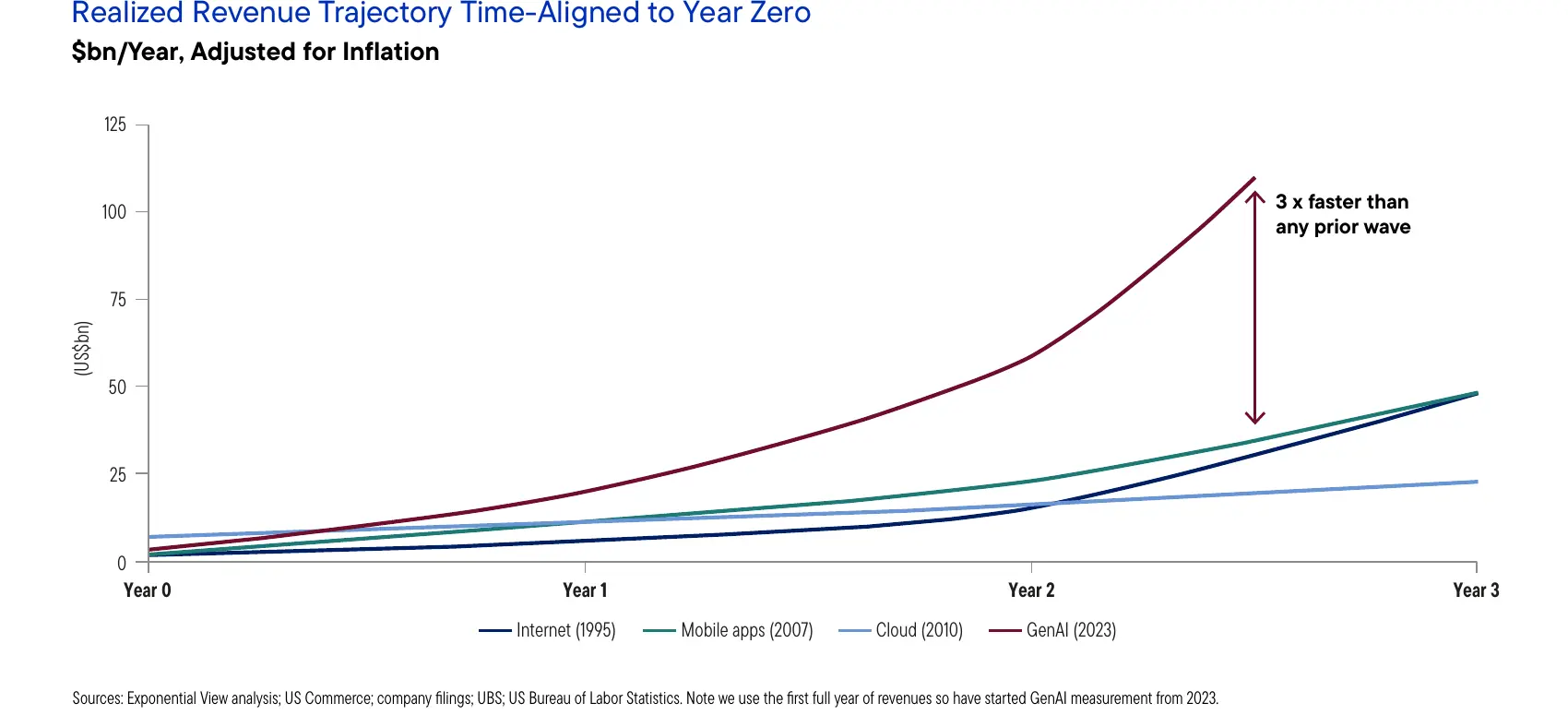
A cycle compressing that fast leaves very little time for advisers to work out where the value actually lands before client portfolios are already positioned, one way or another.
AI infrastructure investment, not the model layer, is where Franklin Templeton’s latest thematic note lands: Franklin Equity portfolio manager Matthew Cioppa argues the obvious question, which companies build the best AI models, is becoming the wrong one to ask.
The more durable opportunity, in his view, is the compute, power, connectivity and, eventually, space that let AI run at scale.
None of the five shifts Cioppa sets out are stock picks. They are a framework for thinking about where the economic value in AI actually lands, one worth having on hand for any adviser fielding questions about how much AI exposure a portfolio already has, and where.
Why the speed matters
Cioppa’s read is that adoption, infrastructure investment and commercialisation are happening at once rather than in sequence, unlike earlier technology cycles.
Internet adoption, then infrastructure spend, then commercial payoff arrived in that order over a decade. But with AI, all three are unfolding together, which is why the manager expects the winners to look different, and quickly.
Two forces are collapsing that sequence into one. Inference costs, what it costs to run a trained model, are falling, opening AI to a broader range of applications. At the same time, hyperscalers keep raising spending on data centres, networking and compute to match that demand.
Falling costs and rising infrastructure spend are usually sequential, one pulling in users before the other catches up. With AI, they are moving together.
Why AI infrastructure investment beats betting on models
If the first phase of AI was about who built the best model, the note argues the second is about who can run models at scale: compute, connectivity, power and, over time, space, which Franklin Equity treats as one system rather than four separate markets. More capable models do not just need more chips. They pull on networking, power and connectivity at once.
For advisers, this recasts a common client question. Exposure to companies building AI models is a narrow slice of the theme; exposure to the businesses supplying compute, power and connectivity is broader and, in Franklin Equity’s view, more durable.
Space as the next layer of the stack
The most unusual argument in the note is that commercial space is becoming part of standard technology infrastructure, not a separate sector.
Franklin Equity points to SpaceX as the clearest example, noting the company has built complementary businesses in launch, communications and AI infrastructure rather than treating launch as a standalone service.
The manager sets out five ways it sees commercial space feeding into the broader stack: global connectivity, launch and in-space logistics, data infrastructure, defence and mission-critical capability, and future compute run in orbit as well as on Earth.
Whether that view holds up will depend on cost curves in launch and satellite manufacturing that are still moving fast, and advisers should treat it as a thesis to watch rather than a settled outcome.
Franklin Equity notes it followed SpaceX while the company was still private, which it says shaped how it now reads new infrastructure platforms generally, often years before they reach listed markets. That is useful context for the thesis, not proof of it.
Early access to a private company does not make the argument correct, but it does explain why it is more developed than a passing observation.
Physical AI and the execution phase
The note closes with two further shifts, and they matter just as much as the first three. One is AI moving into physical systems: robotics and autonomous machines that Franklin Equity expects to spread across manufacturing, logistics and healthcare as costs fall, pointing to China as an early example of how fast that adoption can move once the economics work.
The other is a shift in where returns accrue, from the companies that built the platform (chipmakers, cloud providers, model developers) toward the businesses that use AI to change how they operate.
Cioppa frames this as a familiar pattern in technology cycles. Infrastructure gets built first, applications follow, and new industries form over time. The manager’s view is that AI is now entering that second stage, where the identity of the winners looks different from the first.
Concentration risk does not disappear, it just moves
That broader thesis does not remove the near-term case for caution, though. A handful of companies still account for an outsized share of AI-linked market returns, and that risk does not disappear just because the next phase of the story is wider.
What the note does offer is a vital client conversation: rather than asking whether a portfolio has AI exposure, ask where in the stack it sits, and whether AI infrastructure investment, not just the model layer, is part of the mix. It took three years to build this cycle.
Working out which layer actually pays may not take advisers much longer, but the managers who get it wrong will find out from their clients before they find out from the data.

Cristina is a contributor and content manager at The Inside Network.