Wednesday 4th November 2026
Why cheaper AI is making hyperscaler bonds more expensive

The blended price of AI inference has halved since May while hyperscaler bonds have widened sharply. Bentham Asset Management's Richard Quin explains why the two prices are pulling apart, and what Australian credit portfolios hold.
Falling unit costs normally signal the start of an adoption boom, and the history of technology supports that reading, from the personal computer through to cloud storage.
Richard Quin, chief investment officer at Bentham Asset Management, has been watching two charts that refuse to agree with each other. The price of artificial intelligence has more than halved since May 2026, while the spread on hyperscaler bonds has moved in the opposite direction.
Quin wants investors to think that contradiction through, because the two prices are supposed to travel together. Cheaper inference should widen the market for AI, lift utilisation of the data centres already built and shorten the payback period on the capital going into them. Credit investors have read it differently across 2026, and the two measures have kept travelling apart since.
The price of a token
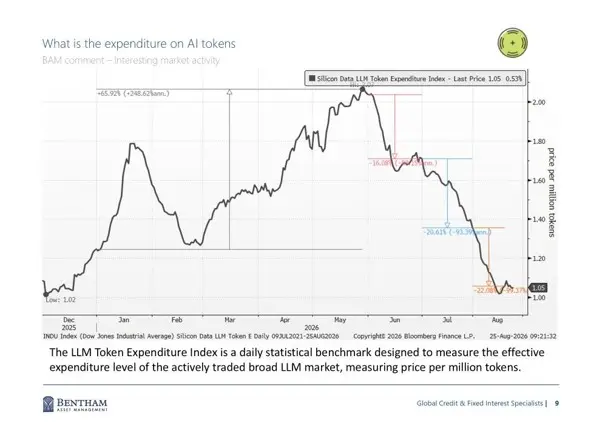
The Silicon Data LLM Token Expenditure Index tracks the blended price the market pays for a million tokens of language model inference, drawing on more than 20 price and volume feeds plus consumption data from routing gateways.
The index bottomed at 1.02 in December 2025, then rose almost 66 per cent between March and a peak of 2.07 in late May 2026. Three successive legs down followed, of 16, 21 and 22 per cent, and the benchmark had returned to 1.05 by 25 August, the date of Bentham’s reading.
The slide continued after that reading, with the index falling to 0.97 on 31 August, rebounding to 1.08 by 9 September, then resuming its decline to 0.94 on 27 October 2026, roughly 54 per cent below the May peak.
“On one hand, lower token costs should be positive,” Quin says. “Cheaper AI means broader adoption, more experimentation and potentially faster productivity gains.”
Hyperscaler bonds reprice
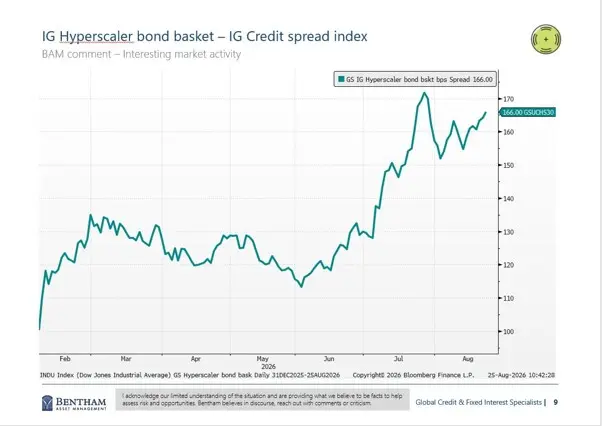
Bond investors have drawn a different conclusion from the same information. The Goldman Sachs investment grade hyperscaler bond basket opened 2026 near 100 basis points over government debt, drifted into the 120s and 130s over the March quarter, then bottomed at 114 basis points in the middle of May.
From there it climbed with barely a pause, peaked above 170 basis points in late July and held at 166 on 25 August. The turn arrived within weeks of the peak in token prices.
“On the other hand, capital markets appear to be asking tougher questions about the returns on the vast sums being invested in AI infrastructure,” Quin says.
Supply explains a good part of the move. J.P. Morgan Asset Management counted US$219 billion of investment grade bonds issued by hyperscalers in the year to 20 August, alongside a further US$62 billion equivalent in euros, sterling, yen, Canadian dollars and Swiss francs.
Global market strategist Jorn Veeneman put duration-adjusted hyperscaler spreads near 105 basis points agGlobal market strategist Jorn Veeneman put duration-adjusted hyperscaler spreads near 105 basis points against roughly 80 for the broader US investment grade market, a widening of about 30 basis points for the year while the wider index gave up two.
The months since have run the same way. Five-year credit default swaps on Oracle reached a record 288 basis points on 15 October 2026. Trepp recorded data centre CMBS spreads widening through October on AI credit risk, and Apollo issued a public caution on hyperscaler debt in mid-September.
Testing the thesis
There is of course a counter argument to the alarm. The token index measures price rather than volume, so it falls when users route work to cheaper open-weight models even as the number of tokens consumed keeps rising.
One routing gateway, OpenRouter, handles more than 10 trillion tokens a day across 400 models. A blended price can therefore collapse while demand grows, which makes the index a weak read on adoption and a sharp read on how much pricing power model providers retain.
The precedent credit investors remember is the fibre build of 1999 to 2001. Bandwidth costs fell, the traffic that justified the network did eventually arrive, and it arrived years after the debt-funded builders had been restructured out of existence.
“History suggests technology often becomes cheaper before it becomes ubiquitous.”
Cheap technology and solvent lenders are two separate propositions, and a bondholder only earns the return if the borrower survives long enough to collect the demand.
What advisers own
Australian portfolios carry this exposure through global credit allocations rather than by deliberate choice.
Hyperscaler bonds made up around 3.5 per cent of the US investment grade index at the start of 2026 on J.P. Morgan’s numbers, with no single issuer above 1.5 per cent, and the firm expects the combined weight to approach 10 per cent by 2030 as issuance runs near US$300 billion a year.
A global aggregate bond fund bought for its defensive qualities increasingly carries a claim on the economics of data centre construction.
AI-related borrowing passed US$455 billion globally across 2026, and banks are preparing up to US$21 billion of investment grade bonds for the first quarter of 2027 to refinance part of Broadcom’s US$63 billion chip-financing package for Anthropic. The market is treating that deal as a test of how much AI debt bond investors will keep absorbing.
J.P. Morgan estimates data centre lease obligations of about US$1.4 trillion across the group, roughly US$1.1 trillion of which stays off balance sheet, alongside unconditional purchase commitments near US$1.5 trillion. Capital expenditure across the hyperscalers has grown from US$156 billion in 2022 to a projected figure above US$1 trillion in 2027.
Quin leaves the question open rather than calling it.
“The question for investors is whether lower costs create enough demand to justify the unprecedented spending cycle we are witnessing today,” he says. “Are falling token costs evidence that AI is becoming commoditised faster than expected? Or a sign of success, fuelling the very adoption the Jevons paradox predicts?”
Either answer changes the return an adviser can expect from global credit over the next three years, which makes the contents of the index a better conversation with clients than the yield printed on the cover.

Cristina is a contributor and content manager at The Inside Network.