Friday 14th August 2026
Why most inherited wealth does not survive the second generation

The research is clear: most Australian family wealth transfer fails not because of bad markets, but because of poor governance and a lack of preparation. Here is what advisers should be doing about it now.
Most advisers assume family fortunes fail because of bad investment calls, poor tax planning or an ugly market cycle. The data says otherwise.
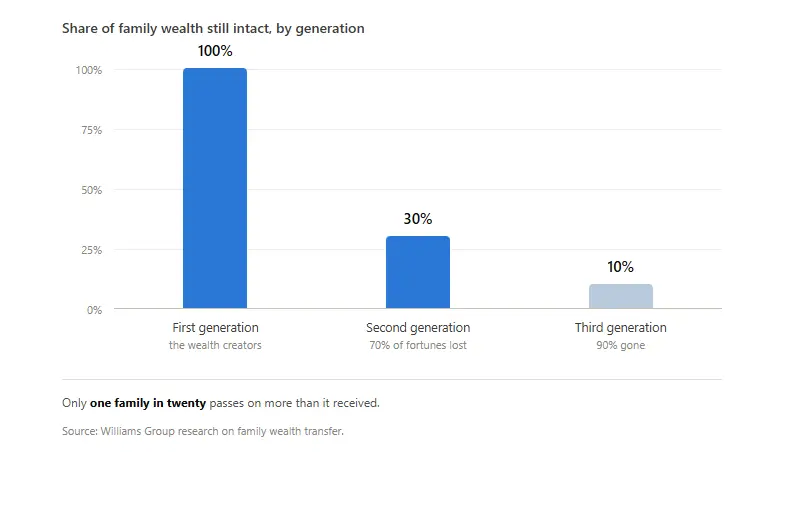
Seventy per cent of Australian family fortunes are lost by the second generation. Ninety per cent are gone by the third. Only one family in twenty passes on more than it received.
These figures come from the Williams Group, the most widely cited research on family wealth transfer. Behind those figures is a bigger number advisers cannot ignore: the Productivity Commission expects around $3.5 trillion to change hands in Australia by 2050.
Inherited assets alone, currently worth about $120 billion a year, will almost quadruple to close to $500 billion a year within 25 years.
For advisers with clients approaching a handover, the real warning in the research is not the failure rate, it is the cause. Tax and market conditions account for only a small share of the losses.
The Williams Group attributes around 60 per cent of failures to a breakdown of trust and communication within the family. A further 25 per cent come down to heirs who were never prepared to receive what they were given.
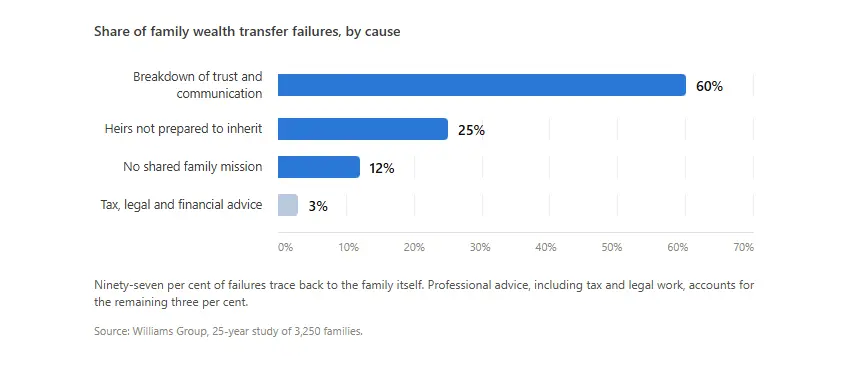
The failure is a governance problem, and it falls squarely in the adviser’s lane, even when it looks like someone else’s job.
The problem is not a shortage of advice
Paul Burgon, chief executive and chief investment officer of wealth governance firm Lipman Burgon, argues that complex families are rarely short of advisers. What they lack is someone accountable for how all that advice fits together. He does not mince words on identifying this pain point:
“The biggest risk for many families isn’t market volatility. It is fragmented decision-making.”
For advisers whose clients span multiple structures, trusts, entities and generations at once, this cuts closer to home than most.
An accountant manages tax. A lawyer manages the trust deed. An adviser manages the portfolio. None of them, by design, owns the question of whether the family actually agrees on who decides what, when the founder is no longer the one deciding.
Joanna Sun, Lipman Burgon’s head of family office design, sees the same gap from the timing side. Governance, she says, is not keeping pace with the transfer already underway.
What “done the work” looks like
The research points to one specific, checkable difference between families that keep wealth intact and those that do not: how early the next generation gets involved.
Burgon says the firm’s longest-standing clients, those it has worked with for more than a decade, generally have the next generation active in family decisions well before any family wealth transfer takes place. Not as observers after the fact, but as participants from the start.
That is a concrete reference point advisers can use in client conversations now, independent of which firm or model a family eventually chooses.
Asking the right questions early is fundamental to getting ahead of a transfer that is already underway.
For clients holding meaningful intergenerational wealth, those questions include: who currently has decision rights across the family’s structures? Has the next generation been part of any of those decisions? And who would be accountable if three different advisers gave three different answers on the same question?
None of this requires a family to overhaul its advice team. It requires someone to ask whether the team is coordinated, and whether the people who will eventually inherit the decisions have had any practice making them.
The family wealth transfer implication
As inherited wealth heads toward $500 billion a year, more advisers will find themselves managing clients on both sides of a handover at once.
On one side, the generation that built the wealth. On the other, the generation about to receive it, often with very different expectations of how decisions get made.
Fortunes are not failing in bad markets. They are failing in family meetings that never happened, over decisions where nobody had agreed who should make them.
Succession planning is not a late-stage technical task. For advisers, it belongs earlier in the relationship, well before the estate plan is the only document doing the work.

Cristina is a contributor and content manager at The Inside Network.