Thursday 6th August 2026
The wrong retention structure can cost you your best adviser, or your exit

Profit share rewards this year's performance. Phantom equity rewards the value an adviser helped build over years. Timeline decides which one fits. Pick wrong and it costs you a key adviser or blows a hole in your own exit.
Principals reach for profit share or phantom equity for the same reason: to reward a key adviser without giving up equity. Reach for the wrong one, though, and it either pays too little to keep them past the next job offer, or hands them a payout large enough to derail your own exit.
The two structures solve different problems. Most practices pick between them without knowing which problem they actually have.
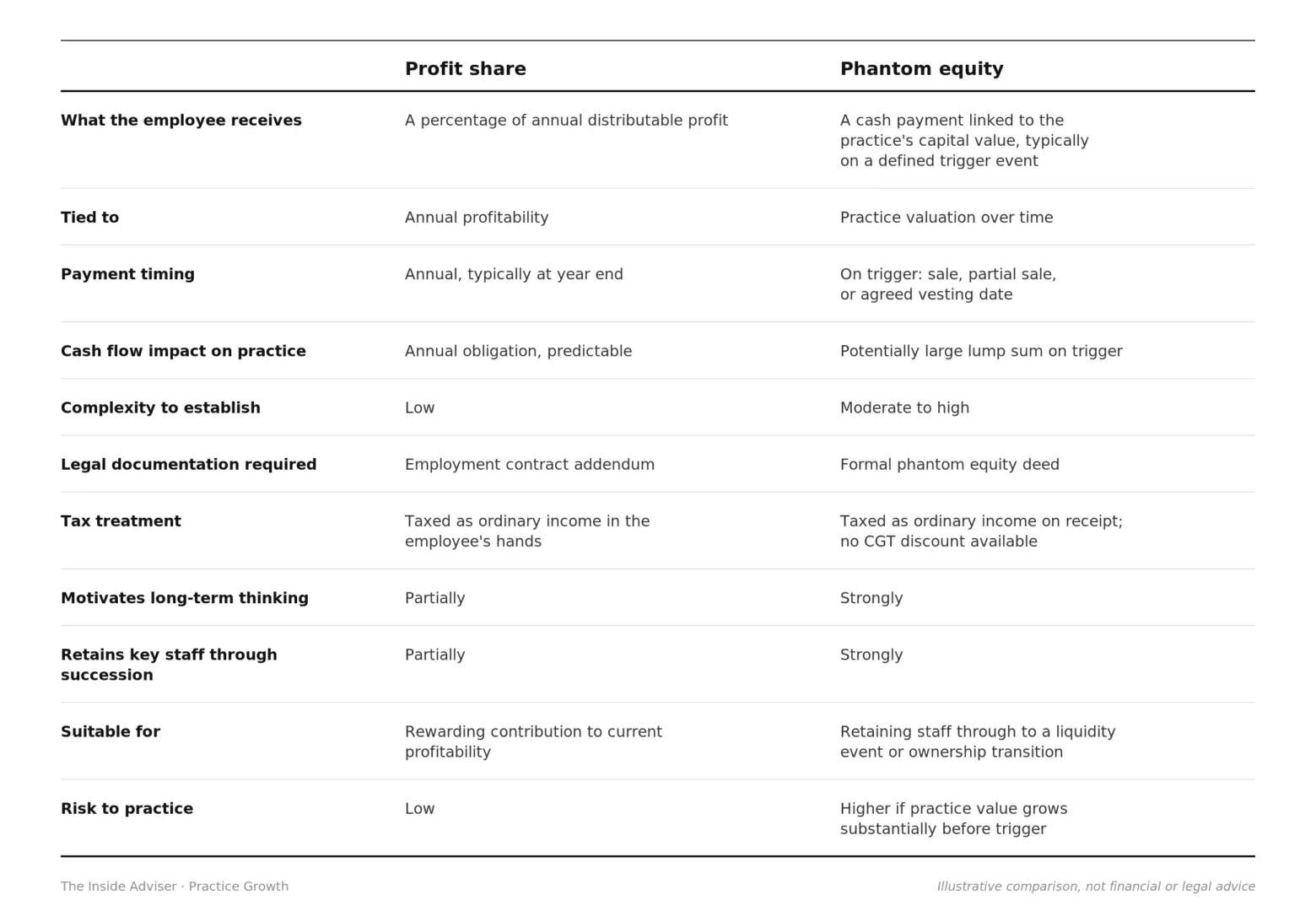
Profit share: fast to set up, tied to one year
Profit share gives a senior adviser a fixed percentage of annual distributable profit, nothing more complicated than that.
Take a practice turning over $500,000 with a 21 per cent margin. Distributable profit lands around $105,000. A 15 per cent share of that is $15,750. Lift the margin to 40 per cent on the same revenue and the same 15 per cent share pays $30,000. The adviser’s payout moves with the practice’s performance, which is the point.
Setting it up rarely needs more than an addendum to the employment contract: the percentage, how distributable profit is defined and when the payment falls due. A lawyer can turn this around in a week.
The gap is what profit share does not do. It pays for this year and stops there. It gives the adviser no claim on the capital value that has built up in the practice, and for most principals that accumulated value, not annual profit, is where most of their wealth sits.
An adviser who helped take a practice from $800,000 to $2 million over five years has clearly added to that number. A profit share cheque does not reflect it.
That makes profit share better suited to the early years of a career path: reward current contribution, keep the adviser engaged and treat it as a step towards something bigger rather than the final answer.
Phantom equity: pays out on the value the adviser helped create
Phantom equity grants a notional stake in the practice’s value, with no shares changing hands and no change to who owns the business. The practice credits the adviser with units equal to a percentage of its value at a set date.
When a trigger event happens, typically a sale, a partial sale or an agreed vesting date, the practice pays the adviser the growth in value since the scheme started, multiplied by their percentage.
Grant an adviser phantom equity equal to 10 per cent of a practice valued at $1.5 million. Five years later the practice sells for $2.2 million. The adviser collects $70,000: 10 per cent of the $700,000 uplift.
That is a materially stronger alignment than profit share offers. The adviser now wants exactly what the principal wants: a practice that retains clients, keeps generating referrals and sells well when the time comes. Their payout depends on it.
It also costs more to set up properly. A phantom equity scheme needs a deed covering the valuation method, the trigger events, vesting conditions and what happens if the adviser leaves before the trigger fires.
Both sides need their own legal advice, and the valuation basis matters more than principals expect: a revenue multiple and an EBITDA multiple can produce very different payouts, so the drafting has to be precise.
The cash flow question principals miss
Ask a principal what worries them about phantom equity and the answer is almost always the same: what happens if the practice sells for more than anyone planned?
Grant 15 per cent and sell for $3 million, and the phantom equity holder is owed $450,000 before the principal sees a dollar of their own proceeds.
That is not a reason to avoid phantom equity. It is a reason to model the numbers before signing anything, and to structure the payment so it comes out of sale proceeds rather than the practice’s operating cash flow.
Worth remembering too: a practice worth enough to trigger a large payout is a practice the adviser helped build. The size of the payment is the size of the contribution.
Which one fits your practice
Timeline decides this more than anything else.
If a sale or ownership transition is two to three years out, phantom equity is the better fit. The deed defines the trigger, the alignment is exactly what a succession process needs, and the legal cost is worth it over that timeframe.
If there is no liquidity event in sight, or you have not yet settled the succession timeline, start with profit share. It rewards what the adviser is doing now, costs little to set up and does not lock the practice into a future capital payment before anyone knows what that payment should look like.
For practices already in active succession planning, the two are not rivals. Profit share now, moving to phantom equity or real equity once the exit timeline firms up, matches the remuneration structure to where the practice actually is, rather than asking one arrangement to do a job you never designed it to do.

Cristina is a contributor and content manager at The Inside Network.