Thursday 13th August 2026
When does financial advice get its own chief AI officer?

Two in three Australian organisations expect to appoint a chief AI officer by 2027. For most advice practices, that corporate curve barely applies. Here is who actually owns the risk of AI in financial advice.
Few, if any, advice practices in Australia have a chief AI officer, even as AI in financial advice becomes part of daily practice. Somebody in that practice is still responsible when the AI gets something wrong.
Two in three Australian organisations expect to have a chief AI officer by 2027, according to new research from Datacom. Small and mid-sized practices make up most of financial advice, so the corporate adoption curve barely applies.
The real question is whether a practice of five, fifteen or fifty people ever needs someone in that seat, and what the job looks like when there is no C-suite to appoint into.
The Datacom report, based on a survey of 507 business and IT leaders, found four in ten Australian organisations have already appointed a CAIO. Sixty-three per cent expect to have one within the next two years. Datacom describes the research as the first of its kind in the Australian market.
The driver is not enthusiasm
It would be easy to assume the CAIO push comes from organisations chasing AI’s upside: faster processes, sharper insights, a jump on competitors. The numbers say otherwise.
Fifty-five per cent of organisations describe themselves as cautious or highly risk-averse on AI, and 22 per cent of respondents cited risk and governance concerns as the leading barrier to stronger AI leadership.
Lou Compagnone, Datacom’s director of artificial intelligence, argues the CAIO role exists to answer that caution with structure.
“Appointing a CAIO can’t just be a title change. The role needs to help the organisation move from pockets of AI activity to a clear, coordinated approach, with the right governance, executive alignment and business ownership in place.”
Who owns the risk in a five-person practice?
It is a shortfall advice practices are already living with. Advisers use AI tools for meeting notes, file notes, portfolio commentary or client communications, often without anyone formally accountable for vetting those tools, tracking where client data goes, or handling what happens when the tool gets something wrong.
Large licensees and institutional platforms can absorb that shortfall into an existing risk or compliance function. A boutique practice usually cannot.
Why an existing role can’t absorb this too
The report’s own numbers point to why a dedicated role, rather than an add-on to an existing job, keeps coming up.
Sixty per cent of respondents nominated developing an AI strategy and roadmap as the top expected CAIO responsibility, ahead of responsible AI governance on 50 per cent. Just 9 per cent named managing vendors and platforms, the task most likely to already live somewhere in a small practice.
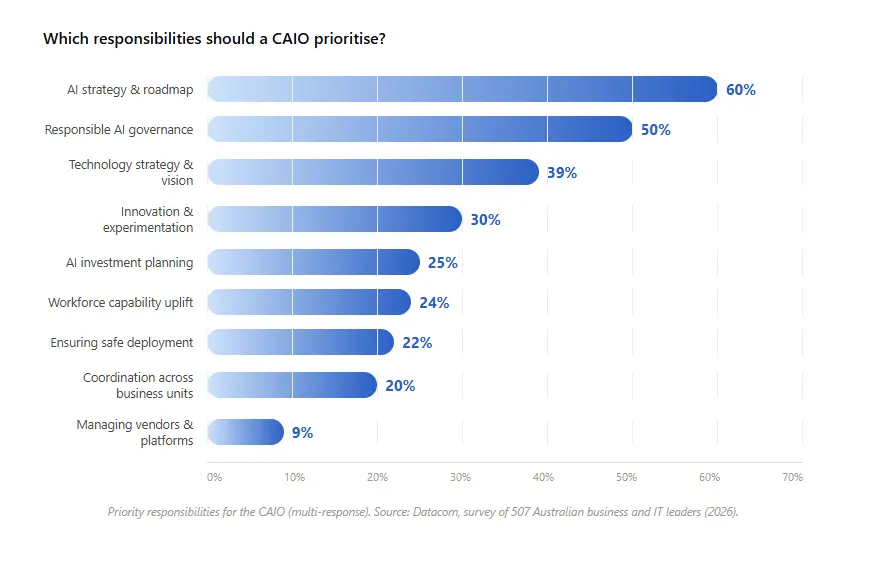
The gap suggests boards and executives see the role as strategic rather than operational, which is exactly the kind of function practices skip when there is no obvious owner.
Most organisations without CAIO plans put that down to overlap with an existing role, commonly the chief technology officer, as 88 per cent of those respondents said.
For advice practices, the overlap is more likely to land with the responsible manager, the compliance lead or, in many single-adviser and small-team practices, the principal themselves. Nobody hired those people to govern AI in financial advice, and few have time to build a roadmap on top of client work.
Government is setting the pace on AI in financial advice
Government is moving faster than the private sector on this. From July, all Australian Government departments and agencies must have appointed a CAIO, and 73 per cent of survey respondents said the mandate has already shaped their own organisation’s approach to AI.
Compagnone expects the influence to spread. “How agencies define and resource the CAIO role will help set the standard for responsible AI leadership, and those expectations are likely to influence organisations well beyond government,” she said.

Cristina is a contributor and content manager at The Inside Network.