Thursday 30th July 2026
Purchasing power is not CPI, and cash is not one currency

Advisers treat “purchasing power” as returns above CPI and “cash” as Australian dollars on deposit. Both shortcuts understate the risk retirees actually carry, and under the design and distribution obligations the language is becoming harder to defend.
Australian advisers talk constantly about preserving purchasing power. It sits underneath retirement modelling, real-return objectives, defensive asset design and target market language.
Yet the term is used far too loosely. In practice, “purchasing power” becomes shorthand for “returns above CPI”, and “cash” becomes shorthand for “Australian dollars on deposit”. Both are too narrow for the world retirees now live in.
A portfolio can beat CPI and still fail to preserve the spending power that matters to a client. A cash holding can be perfectly stable in nominal Australian-dollar terms while the cost of imported essentials, healthcare inputs and travel deteriorates underneath it.
The real question is no longer just whether a portfolio defends against domestic inflation. The deeper question is whether it defends the client’s standard of living in a consumption environment increasingly shaped by global pricing.
CPI is not the retiree’s basket
Purchasing power is the quantity of goods and services money can buy, which immediately raises the harder question: whose goods and services?
Headline CPI reflects one broad, representative basket. A retiree’s basket is far more specific, dominated by housing, utilities, insurance, healthcare, transport and food.
This is why the Australian Bureau of Statistics publishes separate Selected Living Cost Indexes for different household types, including age pensioners and self-funded retirees. The inflation real households face differs from the average household behind CPI.
The point matters more in retirement than in accumulation, because a retiree has fewer levers. A worker can change consumption, lift hours or delay retiring.
Once spending depends on a drawdown strategy and a largely fixed capital base, the exact composition of the basket matters enormously. A CPI-plus objective is a portfolio benchmark, not a promise about a client’s standard of living.
If a retiree’s relevant costs are rising faster than CPI, beating CPI by a modest margin can still amount to a slow bleed in real lifestyle terms.
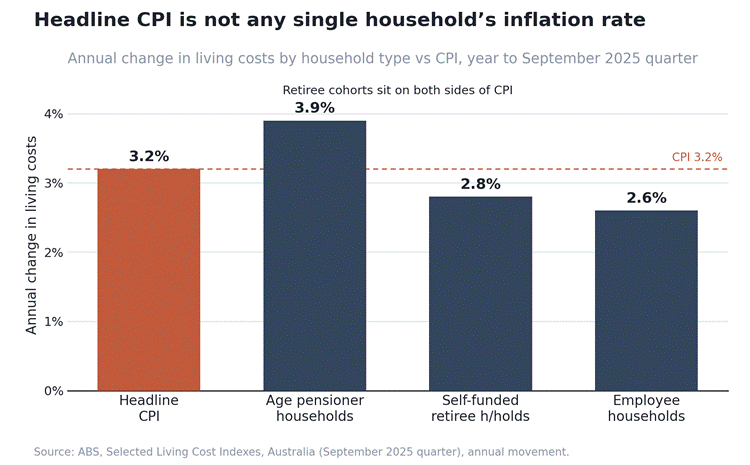
Figure 1. Household inflation diverges from CPI in both directions. Which side a retiree falls depends on their basket, not on the headline rate.
The basket is more global than it looks
Retirement is no longer a purely domestic consumption exercise. Cars, electronics, fuel, pharmaceuticals, medical equipment, travel and many everyday manufactured goods sit inside international supply chains. Even when the final bill is in Australian dollars, much of the price formation happens offshore.
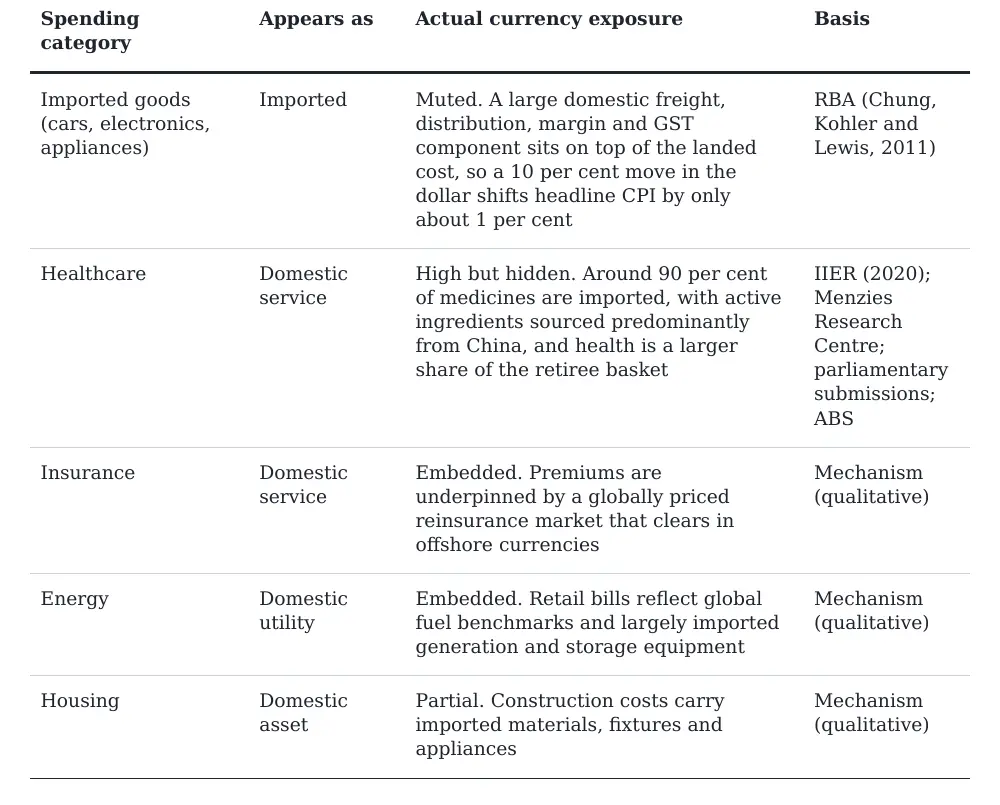
The more important point, which most portfolio discussions miss, is that the line between tradable and non-tradable spending is porous in both directions. Imported goods carry a large domestic component. The retail price of an imported television also pays for local freight, distribution, margin, wages and GST.
This is why the Reserve Bank finds exchange-rate pass-through is only partial. Chung, Kohler and Lewis (RBA, 2011) estimate that a 10 per cent move in the dollar shifts overall consumer prices by only around 1 per cent, and slowly, over roughly three years.
It runs the other way too, and this is the part the industry understates. Domestic-looking categories are built on imported inputs.
Australia imports around 90 per cent of its medicines. A figure from the 2020 Institute for Integrated Economics Research report repeated by the Menzies Research Centre and in parliamentary submissions. Active ingredients are sourced predominantly from China, and the ABS notes health is a larger share of the retiree basket.
The same embedded exposure runs through insurance, underpinned by a globally priced reinsurance market. It runs through energy, exposed to global fuel benchmarks and largely imported equipment. And it runs through housing, built with imported materials and appliances.
Currency exposure in the retiree basket is therefore diffuse and embedded, not a line item advisers can wave away by pointing out that the client “spends in Australian dollars”.
The tradable and non-tradable line is porous in both directions
Cash is a currency decision
So many clients experience inflation through a currency channel as much as a domestic one. When the Australian dollar falls, the imported content of the basket becomes more expensive. It concentrates in the discretionary, big-ticket areas where retirees can least substitute. Travel, imported durables, fuel and the offshore-linked slice of medical costs.
Many clients experience purchasing power less as “what CPI says” and more as “what my dollars buy in a world increasingly priced in USD”.
Their account balance is in Australian dollars. Their life is not.
This is where treating cash as one homogenous category fails. Cash is a short-term claim on a monetary regime. Australian-dollar cash is a claim on Australian inflation, policy settings and the real exchange rate. US-dollar or Swiss-franc cash is a different claim.
In the safe-haven currency literature, Ranaldo and Söderlind (Review of Finance, 2010) document the Swiss franc and Japanese yen appreciating against the US dollar in risk-off episodes. The broader literature treats the US dollar, Swiss franc and Japanese yen as the core safe-haven currencies.
The Australian dollar is well managed but small and open, and it tends to fall in exactly the risk-off episodes when imported costs face the greatest pressure.
The obvious objection, met
The obvious counter is liability matching. If a retiree spends in Australian dollars, then Australian-dollar cash is the matching asset. Foreign currency only injects exchange-rate volatility into the bucket whose job is stability. That is right for the genuinely domestic, labour-driven share of spending, which is why the answer is a modest, targeted sleeve rather than a wholesale reallocation.
But it is weaker than it first appears. The “you spend in Australian dollars” premise is only partly true once embedded import content is counted. The Australian-dollar bill for medicines, insurance, energy and travel is itself a claim on offshore costs.
The liabilities most currency-exposed, including offshore travel, family support abroad, big-ticket imports and imported medical inputs, are precisely the ones a small foreign-currency holding is suited to hedge. The frame is not “match the whole basket in Australian dollars” but “match the currency-exposed tail with a currency-exposed asset”.
Even the “safe” assets can lose real value
Advisers often assume growth assets will repair cash’s real erosion over time. The best cross-country evidence tempers that.
Anarkulova, Cederburg and O’Doherty, in “Long-Horizon Losses in Stocks, Bonds, and Bills”, estimate 30-year real loss probabilities of around 37 per cent for bills, 27 per cent for bonds and 13 per cent for domestic stocks. International stocks come in far lower, at around 4 per cent. The authors attribute the gap to exchange-rate movements offsetting domestic inflation.
That finding is about equities rather than cash and should be extended carefully. But the mechanism is exactly the one a currency-diversified liquidity sleeve relies on.
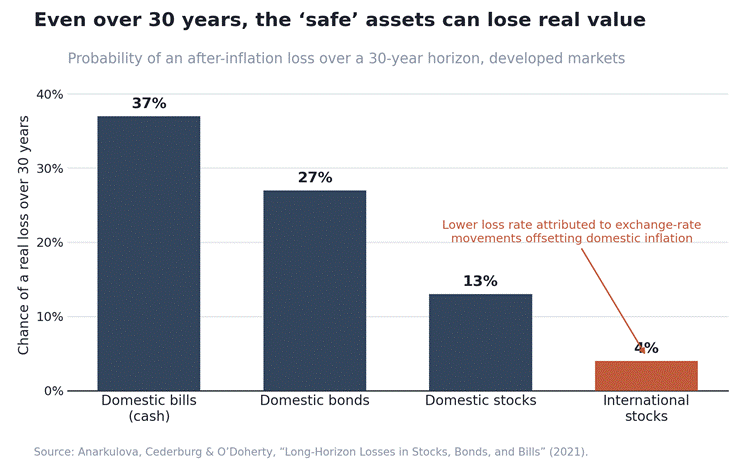
Figure 2. Over a retirement-length horizon, the asset most often treated as safe carries the highest real-loss risk, and the currency-exposed asset the lowest.
What a modest sleeve is for
A modest multi-currency liquidity sleeve reduces the concentration risk of holding all reserves in one cyclical currency, cushions imported inflation when the dollar weakens, preserves optionality for offshore spending such as travel or family support, and partly hedges the embedded offshore content of a basket bought in Australian dollars
None of this turns retirees into currency traders or makes foreign-currency cash a free hedge. There are spreads, custody, tax and behavioural costs, which is exactly why the sleeve should stay modest and sized to the currency-exposed tail. But “all cash equals Australian dollars” is itself a macro bet, and often a larger one than advisers or product issuers admit.
Where this bites: the appropriateness test
This is not a soft disclosure point. It goes to the appropriateness requirement in the design and distribution obligations.
Under section 994B(8) of the Corporations Act, an issuer may only make a target market determination where it is reasonable to conclude that the product, including its key attributes, is likely to be consistent with the target market’s likely objectives, financial situation and needs.
ASIC’s September 2024 amendment to RG 274 softened what must be written into the determination, but not the obligation to reach a defensible conclusion. Three categories are exposed on the argument above.
The first is real-return or CPI-plus funds, whose “preserve real capital” language leans on domestic CPI as a cost-of-living proxy.
The second is capital-stable and enhanced-cash products sold to retirees, where nominal Australian-dollar stability stands in for purchasing-power preservation.
The third is retirement-income products whose target market invokes maintaining a standard of living while the construction is domestic-CPI-relative and entirely in Australian dollars.
The fix is alignment, not disclosure
None of this says any issuer has failed the test. The point is that the appropriateness assessment should be able to survive the question. If a determination invokes purchasing power or standard of living, the issuer should be able to say why domestic CPI and an all-Australian-dollar defensive sleeve are consistent with that need.
Where the honest answer is that the language reached for a real-world outcome the product does not target, the fix is not a larger disclaimer, but to align the language with what the product delivers, or the product with what the language promises.
The same discipline runs down to the adviser, who still owes the client an assessment against their real basket. A CPI-linked objective is a measurable benchmark; preserving purchasing power is a real-world outcome. Treating the first as if it discharges the second is the error this piece is arguing against.
The practical frame
For advisers, purchasing power should be treated as a balance-sheet concept, not a performance-reporting one. The question is not “how did the portfolio go against CPI?” but “what is the client implicitly long, what do they actually spend on, and how exposed is that spending to one domestic currency regime?”
A more honest framework distinguishes CPI from client-specific living costs, recognises the import content that domestic-looking categories carry, treats cash as a currency decision rather than an asset-class default, and reserves the phrase “preserve purchasing power” for cases where the portfolio and the benchmark match how global markets actually price the client’s life.
In a world where the statement shows Australian dollars but global markets increasingly drive lifestyle costs, the denomination of liquidity matters more than the industry has been willing to admit.
Advisers do not need to abandon domestic cash or turn every retiree into a macro strategist. But they need to stop pretending that purchasing power is fully captured by CPI, and that cash is a universal category with no geography attached.
For a profession built on protecting clients against the risks they do not see coming, that is the defensive conversation that needs to happen next.

Ben is a principal consultant at WealthVantage Partners and is an expert in research for the financial advice ecosytem.